
Enhancing Your Vision
Guiding you toward the procedure that fits your unique needs, so you can see the world clearly and confidently.

Published: 28 Sep 2026
If you've been searching "best cataract lens" and hoping to land on a single, clear answer, you're not alone — and you're also asking the wrong question. Dr. Ilan Cohen hears some version of this search every week from patients sitting in his office, phone in hand, half a dozen browser tabs open.
Here's what 25 years and tens of thousands of implanted lenses have taught Dr. Cohen: there is no universal "best" lens. There's only the best lens for your eyes, your expectations, and your lifestyle. Below is the same framework he walks his own patients through — the four lens categories on the market, the three questions that actually determine which one fits you, and an honest, unsponsored take on what's generating buzz in 2026.
Most people research lenses in isolation, as if the lens alone determines the outcome. It doesn't. A lens is only as good as the plan around it — accurate preoperative measurements, precise surgical execution, and proper post-op care. Get any one of those wrong and even the "best" lens on paper won't deliver.
So the more useful question isn't "what's the best lens?" It's "what are my options, and how do I find a surgeon who can deliver the one that's right for me?" The answer depends on your visual goals, the current health of your eyes, whether you've had prior vision correction like LASIK, and whether conditions like macular degeneration or glaucoma are in the picture.
Rather than getting lost in dozens of brand names, it helps to think in categories.
Monofocal Lenses
The standard lens used in cataract surgery for decades. It delivers excellent clarity at one fixed distance — usually far away. The tradeoff: you'll need reading glasses for anything up close, like your phone or a menu. This is a solid choice for patients who don't mind wearing readers (and possibly distance glasses, if astigmatism is present).
Monofocal Plus / Extended Depth of Focus (EDOF)
These stretch your range of vision beyond a standard monofocal, providing clear distance and solid intermediate vision — think computer screens and dashboards. You'll likely still need readers for fine print, though significantly less often than with a standard monofocal. EDOF lenses tend to suit patients who live on their computers and want a wider functional range without the visual tradeoffs of a multifocal.
Multifocal / Trifocal Lenses
Designed to provide vision at far, intermediate, and near distances simultaneously. More than 90% of patients with these lenses report little to no dependence on glasses afterward, and in Dr. Cohen's experience, satisfaction runs above 95%. The tradeoff is a possibility of halos or rings around lights at night, especially in the first few months — something the brain typically adapts to. This category is best for patients who are motivated to be glasses-free and willing to accept a short adjustment period.
Toric Lenses (Astigmatism Correction)
Not a separate category so much as an add-on available across all three lens types above. If you have astigmatism — and many cataract patients do — a toric lens corrects it during surgery. Skip it, and your distance vision may stay blurry even after an otherwise successful procedure. Toric monofocal lenses, in particular, are one of the most underrated options available today: simple, reliable, and excellent for patients who mainly want sharp distance vision.
Once you understand the categories, the next step is a bit of self-assessment.
1. What does your daily life actually look like?
If you drive often and play golf on weekends, sharp distance vision matters most — an EDOF, toric, or monofocal lens may fit best. If you read for hours or do detailed close-up work, a trifocal is worth serious consideration. If your day is spent at a computer, EDOF may be the sweet spot.
2. How do you feel about wearing glasses after surgery?
Some patients are perfectly happy with a pair of readers. Others want total independence from glasses. Neither answer is wrong, but it changes the recommendation significantly. The general tradeoff: the more glasses-free your lifestyle goal, the more likely you are to notice some glare or halos at night. Most patients either don't notice these effects or aren't bothered by them, but it varies by individual.
3. What is your eye health like beyond the cataract?
Conditions like macular degeneration, glaucoma, or significant dry eye can affect how well certain lenses perform — and this is a question only your surgeon can answer after a full exam. Ask directly: based on my eye health, which lens categories are realistic for me?
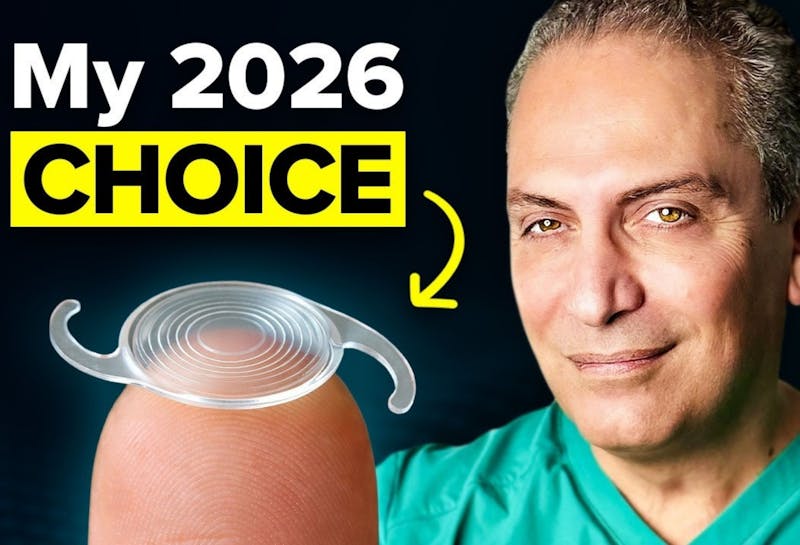
What's new. Dr. Cohen has been particularly impressed with the Envista Envy lens over the past year. It delivers clear vision across far, intermediate, and near distances with a notably low complication rate — he has yet to perform a single lens exchange on an Envy patient, despite regularly seeing referrals for exchanges involving other lens brands. He's also excited about the FineVision trifocal, newly approved in the U.S. and designed to minimize glare while providing clarity at every distance. Dr. Cohen was the first surgeon in the tristate area to implant this lens.
What's overhyped. Light adjustable lenses. The concept — fine-tuning the lens after surgery — is interesting, but in Dr. Cohen's view, the added cost and additional office visits often don't justify the results for most patients.
What's underrated. Toric monofocal lenses. Simple, dependable, and a great fit for patients who mainly want strong distance vision without complexity.
If Dr. Cohen were choosing for himself in 2026, he'd weigh his own visual needs, his desire for glasses freedom, and his corneal topography — and based on those factors, he'd choose the Envy lens. That said, every patient's eyes and lifestyle are different, and yours may point in a different direction entirely.
Be cautious with industry-sponsored studies, even ones published in respected journals — funding sources can shape how results are framed. And be skeptical of marketing that promises "perfect vision" or "complete freedom from glasses." Premium lenses are designed to reduce dependence on glasses; more than 90% of multifocal patients use no glasses at all, but no lens can guarantee 100% independence in every lighting condition.
Before committing to a lens or a surgeon, ask:
There's no single "best" lens — only the lens that's best matched to your eyes, your goals, and your surgeon's ability to deliver it. Understanding the four categories, answering the three questions above, and coming prepared with the right questions for your consultation will put you in a far stronger position than chasing a marketing claim.
If you'd like personalized guidance, Dr. Cohen offers consultations — including virtual options for patients outside the area — to walk through exactly which lens category fits your life.
Have questions about which lens category is right for your eyes, or wondering how your lifestyle and eye health should shape that decision? Schedule a consultation with Cohen Eye Institute to get personalized guidance based on your eyes, your lifestyle, and your goals.
Guiding you toward the procedure that fits your unique needs, so you can see the world clearly and confidently.



If you do not see your preferred date and time please call the office, so we can accommodate your request (917) 398-4011.