
Enhancing Your Vision
Guiding you toward the procedure that fits your unique needs, so you can see the world clearly and confidently.

Published: 01 Oct 2026
A little blurriness in the first few days after cataract surgery can be normal while the eye settles. But blurry, hazy, or distorted vision that shows up two or three weeks later — after things were supposed to be clearing up — is not something to brush off. That's often a sign of a real, specific complication, and in many cases, it traces back to something as simple as which bottle of eye drops ended up in your hand at the pharmacy.
Dr. Ilan Cohen, a board-certified cataract and premium lens surgeon with 25 years of experience, has noticed this pattern repeat itself across tens of thousands of surgeries. Below, he breaks down what's actually happening, why it matters so much, and exactly what to check before you ever leave the pharmacy counter.
If your vision looks foggy or faded weeks after what should have been a smooth recovery, the cause usually isn't the surgery itself. It's a complication called Cystoid Macular Edema, or CME.
CME happens when fluid leaks into the macula — the part of the retina responsible for your sharpest, most detailed vision. When that area swells, vision becomes hazy, distorted, or washed out, even if the surgery itself went perfectly.
Here's the part most patients don't expect: CME is almost entirely preventable with the right eye drop. The problem is that the right drop doesn't always make it into the bottle you walk out with.
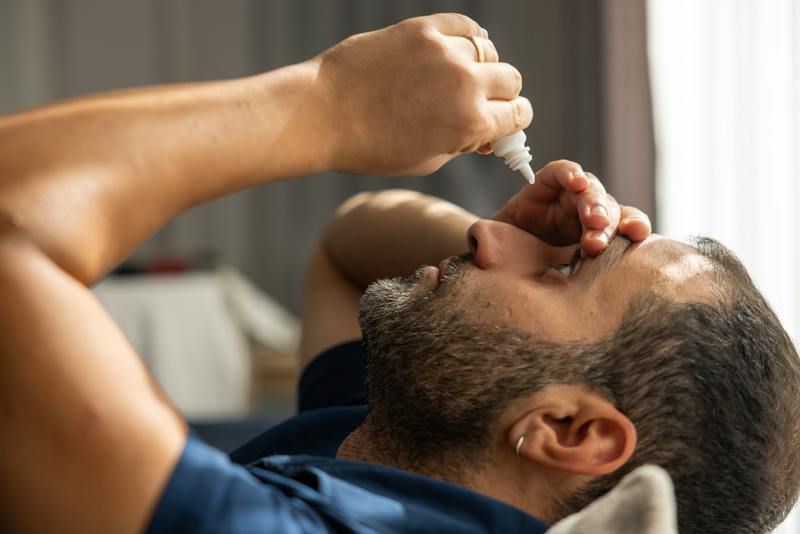
After cataract surgery, patients are typically sent home with three types of drops:
The NSAID is the one doing the heavy lifting for CME prevention specifically. Several options exist — Ketorolac, Nepafenac, Diclofenac, and Bromfenac — and on paper, they can look interchangeable. In real-world outcomes, they are not.
Multiple clinical studies, along with Dr. Cohen's own experience across tens of thousands of eyes, point to Bromfenac as consistently superior at protecting the back of the eye. The reason comes down to how the drop is built, not just what's on the label.
Think of the eye like a layered onion. For a drop to actually protect the retina, it has to pass through layer after layer of tissue and still have enough strength left to do its job once it arrives.
Bromfenac's chemistry is designed to survive that trip — penetrating deeper and staying active longer than the alternatives. Other NSAIDs tend to lose potency before they ever reach the structures they're meant to protect. Even though some formulations are labeled for once-daily use, Dr. Cohen prefers dosing it twice a day for added coverage.
When Dr. Cohen's practice shifted every patient to Bromfenac, CME rates dropped to near zero. The cases that still occasionally showed up had one thing in common: the patient had ended up on a different drop instead.
This is the frustrating part — even when a doctor prescribes Bromfenac by name, a few things can still get in the way between the prescription pad and the pharmacy counter:
They are not equivalent. And often, no one explains the swap. The bottle looks similar, the name sounds close enough, and the patient has no idea anything changed — until the blurriness shows up weeks later. Even some physicians aren't fully aware of how meaningful this gap is, and assume all NSAID drops perform the same way.
If you're about to have cataract surgery, ask your surgeon:
"Can you write 'Do Not Substitute' on my NSAID prescription?"
This single note makes it much harder for a pharmacy to swap the drop automatically.
If you're picking up your prescriptions, before you leave the counter:
If you're already a few weeks past surgery and your vision looks foggy, distorted, or just "off":
Call your doctor right away.
CME caught early is usually reversible. The longer it goes unnoticed, the harder it can be to fully resolve.
Cataract surgery today is more precise and predictable than it's ever been. But a great outcome in the operating room doesn't guarantee a great outcome afterward — recovery depends on the small, ordinary details that happen outside the surgeon's office, including exactly which drop ends up in your hand at the pharmacy.
Not all NSAIDs are interchangeable, even when they sound alike and sit on the same shelf. Pharmacies substitute for practical reasons — insurance, inventory, margins — but you only have one pair of eyes, and small differences in medication can mean big differences in how clearly you see for the rest of your life.
Concerned about blurry or distorted vision after cataract surgery? Schedule a consultation with Cohen Eye Institute to find out what's really going on — and get a clear plan to protect your vision.
Guiding you toward the procedure that fits your unique needs, so you can see the world clearly and confidently.




If you do not see your preferred date and time please call the office, so we can accommodate your request (917) 398-4011.