
Enhancing Your Vision
Guiding you toward the procedure that fits your unique needs, so you can see the world clearly and confidently.

Published: 03 Jun 2026
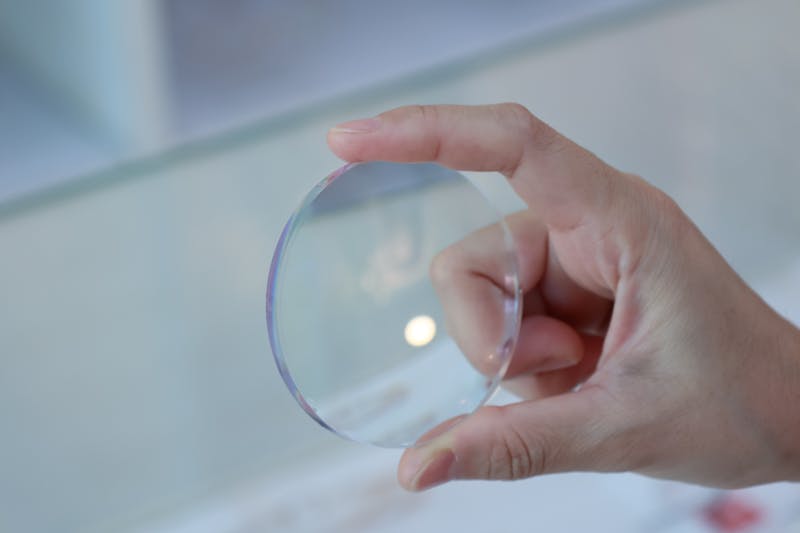
A new premium cataract lens called PureSee entered the market in 2026 and it takes a meaningfully different approach than anything currently available in the U.S. As one of the first surgeons in the Tri-State area to use it, and with approximately a dozen implantations already performed, here is an honest, early clinical perspective on what this lens does well, where it falls short, and how surgical planning can dramatically change the outcome.
Note: No manufacturer compensation influenced this review. All observations are drawn from direct patient experience.
In cataract surgery, the cloudy natural lens inside the eye is removed and replaced with a clear artificial one. The type of lens chosen determines how much, and at what distances, a patient can see without glasses afterward. A basic (monofocal) lens provides sharp vision at one fixed distance, typically far. Glasses remain necessary for most other tasks.
A premium lens attempts to provide a range of vision, reducing or eliminating dependence on glasses. Most premium lenses accomplish this by dividing incoming light into separate focal points: one for distance, one for intermediate, and one for near. This approach works well for many patients, but for some, the split light manifests at night as rings, starbursts, or glare around headlights.
PureSee takes a different approach. Rather than splitting light, it gently stretches a single, smooth zone of focus. The goal is a wider visual range without the visual artifacts that some patients experience with traditional multifocal designs.
It is also the first lens of its kind cleared in the U.S. with no warning regarding contrast loss, meaning it is designed to preserve the richness of vision that allows a driver to distinguish a gray car on a gray road in low light.
Based on early patient outcomes, PureSee is delivering on its core promise of visual quality.
Night vision has been clean. Glare and halos, the most common complaint with traditional multifocal lenses, have been minimal to nonexistent. Contrast sensitivity appears preserved. When patients report that headlights look like headlights again, rather than surrounded by light bursts, that is a meaningful clinical outcome.
There is also a structural advantage worth noting: PureSee is not highly sensitive to decentration. Most premium lenses, including other Extended Depth of Focus (EDOF) lenses like the Vivity, require very precise centering during surgery. Even slight misalignment can be a primary driver of patient dissatisfaction. Because PureSee has no rings and no small central element that requires perfect positioning, this surgical challenge is eliminated entirely.
Visual quality is not the whole picture. Range, the ability to see at near and intermediate distances without glasses, is where PureSee currently shows a limitation.
Compared to the Vivity, a leading EDOF competitor, PureSee has come in slightly behind on both near and intermediate vision in early cases. Compared to full multifocal lenses like the Envy, which are purpose-built for strong reading performance, the difference is more pronounced.
To be direct: these are early impressions based on a limited number of cases. It is too soon to draw definitive conclusions. But the pattern is consistent. PureSee trades some range in exchange for cleaner visual quality. That is not a flaw. It is a design philosophy. Whether it is the right trade-off depends entirely on the individual patient.
The lens itself is only part of the outcome. How a surgeon plans and executes the procedure often matters just as much. Two approaches have shown meaningful benefit in early PureSee cases:
1. Micro-Monovision
Rather than targeting both eyes for sharp distance vision, one eye is set for distance-to-intermediate and the other is aimed slightly closer. The brain integrates both images seamlessly, a process it performs constantly. The result is a noticeably expanded functional range, with improved performance at phone and computer distances, while preserving the clean, glare-free quality that PureSee provides.
2. Mixing Lenses Between Eyes
A patient does not need to receive the same lens in both eyes. One approach is to implant PureSee in one eye, capturing its strength in distance and night vision quality, while placing a lens like the Vivity or the Envy in the other eye to recover near and intermediate range. Each lens does what it does best. The visual system blends the two, and the patient gains the advantages of both designs.
This kind of individualized, mixed-lens planning is where surgical judgment plays a defining role. The same lens can produce an average result without a thoughtful plan, and an excellent result with one.
PureSee is likely a strong fit for patients who:
It is likely not the best primary choice for patients whose top priority is complete freedom from reading glasses. In that case, a full multifocal lens such as the Envy may be the more appropriate recommendation.
There is no universally correct answer. The right lens is the one that best matches how a patient lives, and the right plan is the one designed around that match.
When consulting with a cataract surgeon, the most useful question is not "What is the best lens?" It is "What is the best plan for the way I live?"
Come prepared to discuss:
That conversation will do more to shape a successful outcome than any single lens selection.
Dr. Ilan Cohen is a board-certified cataract and premium lens surgeon with 25 years of experience and tens of thousands of cataract and lens exchange procedures performed. Call our office today to schedule a consultation.
Guiding you toward the procedure that fits your unique needs, so you can see the world clearly and confidently.




If you do not see your preferred date and time please call the office, so we can accommodate your request (917) 398-4011.